&w=3840&q=75)
The .claude folder
)
2 years ago, the accusation of being a vibe coder stung as much as being called basic. Now it's an everyday practice for even the most serious of engineers.
Over time we've created standards by implementing rules files, we've given LLMs dominion over repeatable tasks through skills, and fine configured our model personas using agents files.
We create each of these within a special folder, .claude, and build a directory structure akin to this:
.claude/
├── agents/
│   └── agent-name.md
├── rules/
│   └── rule-name.md
└── skills/
    └── skill-name/
        └── SKILL.md
Then at the root of our repo we create our CLAUDE.md file with a walkthrough of the platform.
It has also vendor-locked you into Claude Code - No Cursor or Open Code for you.
I often find myself switching between TUI and GUI depending on the size of the problem I'm solving. I want my agents, rules and skills to be transferrable, and .claude is only going to work for Claude Code.
Introducing the .agents folder
A simple cross platform solution is to use the .agents folder, and it's basically the same thing, but now it's not vendor specific.
The agents folder follows the exact same structure as the .claude folder, and as other coding platforms hit the market, I'd expect them to adopt it as the standard. It's even already baked into Skills.
Let's take a look at our new structure... well it's our old structure, just with a new name.
.agents/
├── agents/
│   └── agent-name.md
├── rules/
│   └── rule-name.md
└── skills/
    └── skill-name/
        └── SKILL.md
Look familiar? It should do.
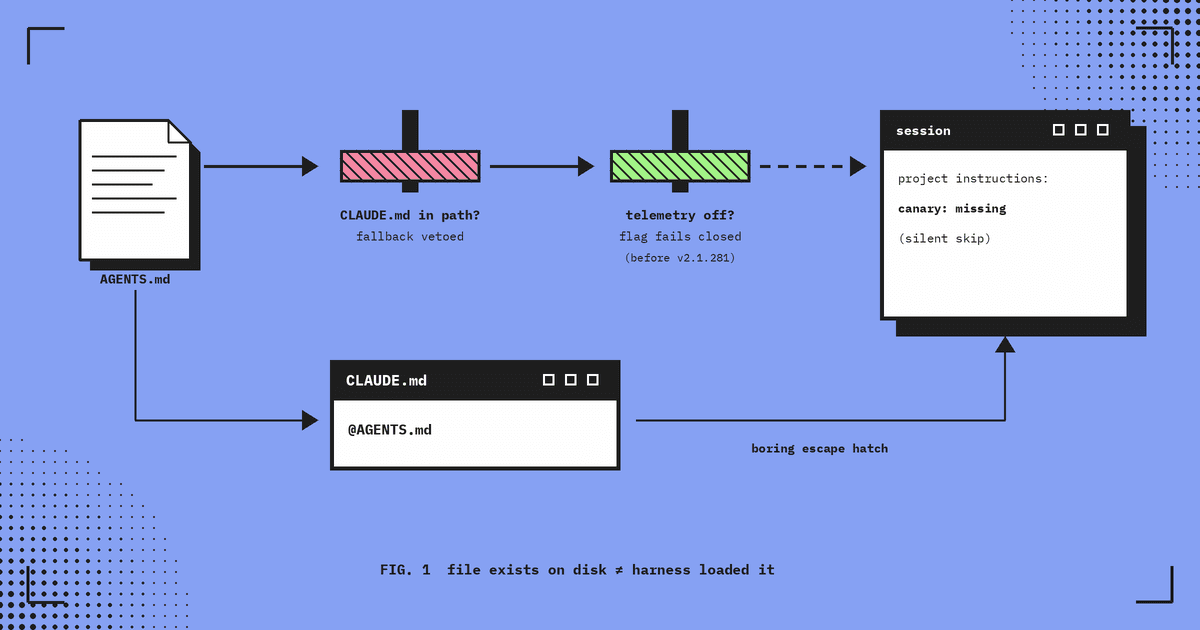
The catch is that Claude Code only looks into the .claude folder.
Can we make this work for Claude Code?
As of March 2026, there are a lot of platforms adopting the .agents folder to house our new AI powers. But Claude Code doesn't pick it up.
)
The answer is actually incredibly simple - the Symbolic Link (or symlink).
The simplest way to describe a symlink is that it's a virtual file or folder, that points to another "real" file or folder.
.claude/
├── agents/
│   └── agent-name.md -> .agents/agents/agent-name
├── rules/
│   └── rule-name.md  -> .agents/rules/rule-name
└── skills/
    └── skill-name/   -> .agents/skills/skill-name
        └── SKILL.md
This now allows Claude Code to read and update the skill in a way that seems native to .claude, and it's super easy to create a symlink:
ln -s ../.agents/agents/agent-name.md .claude/agents/agent-name.mdBreaking this one-liner down, it links symbolically from the real file, to a virtual file.
This is the bit that "fools" Claude into thinking you've got a .claude directory.
We can even configure git to allow our new virtual filesystem to be stored in the repo:
git config core.symlinks trueWhat about CLAUDE.md?
Well we treat it exactly the same - create a non-vendor specific AGENTS.md and symlink it to make it backwards compatible.
ln -s AGENTS.md CLAUDE.mdWhat about Cursor and Open Code?
)
Open Code is great, no work needed, .agents is the default and it turns out that Cursor has their own proprietary version of this exact pattern too, and the same solution works for Cursor too!
ln -s ../.agents/agents/agent-name.md .cursor/agents/agent-name.mdThus creating a virtual directory structure which looks like this:
.cursor/
├── agents/
│   └── agent-name.md -> .agents/agents/agent-name
├── rules/
│   └── rule-name.md  -> .agents/rules/rule-name
└── skills/
    └── skill-name/   -> .agents/skills/skill-name
        └── SKILL.md
Thoughts
You know, I love the .claude folder. It's simple, it's powerful, and allows you to create persistent superpowers for your project. Which is why I love the .agents pattern.
It's time we applied some generalised thinking to how we set up our AI tooling! Not everything needs to be proprietary. Avoid the vendor-lock and symlink.